
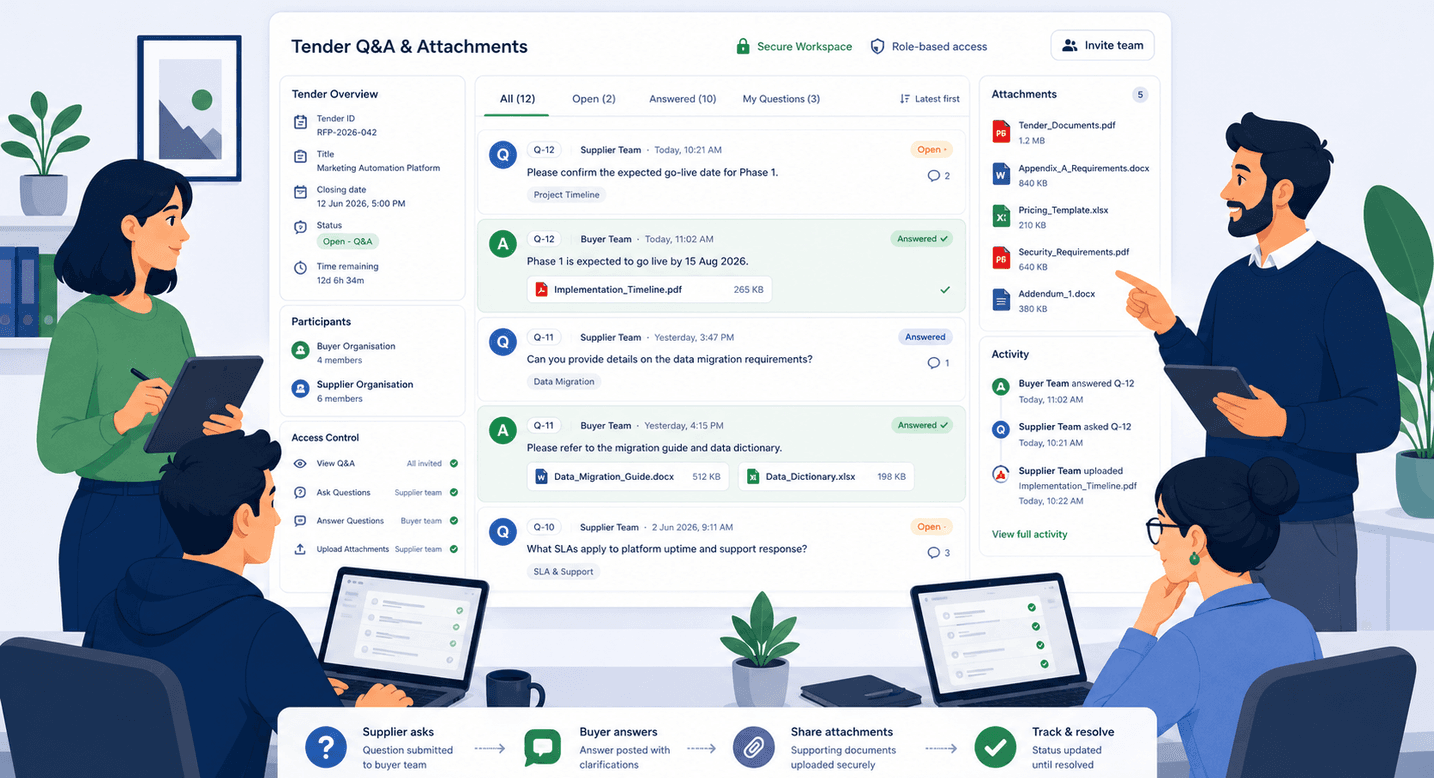
How a multi-location delivery business replaced scattered tender clarifications with threaded, access-controlled Q&A and attachment handling.
Context
A a multi-location delivery business, needed a better way to handle tender clarifications between internal teams and invited subcontractors. Questions were happening, but they were spread across email chains and hard to track once projects got busy. People could miss updates, duplicate requests, or lose context when new team members joined mid-stream.
The product direction was to make questions part of the platform workflow instead of a side channel. That meant threaded conversations, clear ownership, and controlled document sharing that worked for both operational teams and subcontractors.
Challenge
The challenge was balancing collaboration with strict visibility rules. Organisations should only see their own question threads. Internal users needed visibility based on role and notification group membership, not broad access by default. Attachments had to be easy to upload and download, including bulk download, while staying tied to the right message and user.
There were also lifecycle details that matter in real operations. A question can be resolved, then reopened when new information appears. Non-open tenders should still allow questions from organisations that are already invited or have an active application, but block unrelated parties.
Approach
I implemented a structured question flow with a first message at creation, then follow-up replies in the same thread. Each reply updates the conversation state, and adding a new reply automatically reopens previously resolved questions so nobody misses renewed activity.
Access checks were handled at both route and record level. Organisation users are restricted to threads for their own organisation, while internal access is governed through notification group subscriptions. This kept visibility intentional and auditable.
Attachment handling was designed for day-to-day usage, not just happy-path uploads. Users can attach supported file types at question creation or later messages, download individual files, and download all files in a generated zip archive. Duplicate filenames are made unique during zip assembly, and missing files are skipped safely so one bad file does not break the whole download.
Notifications run both directions. Internal recipients are alerted when a subcontractor raises or replies to a question. Organisation recipients are alerted when internal teams reply, with preference-aware behaviour for organisation members who opt in or out of colleague updates.
Outcome
Operationally, this replaced fragmented clarification handling with a single workflow that keeps context intact from first question to final resolution. Teams spend less time forwarding updates and more time responding to actual issues.
The flow is also more predictable under pressure. Access is locked to the right participants, message history stays in one place, and attachment handling supports practical scenarios like bulk download for review meetings. Notification behaviour is explicit, which helped reduce noisy updates while still keeping the right people informed.
Key takeaway
Collaboration features work best when they combine conversation quality with strict boundaries. Threading, access control, and preference-aware notifications together turned tender Q&A from ad hoc messaging into a dependable operational process.