
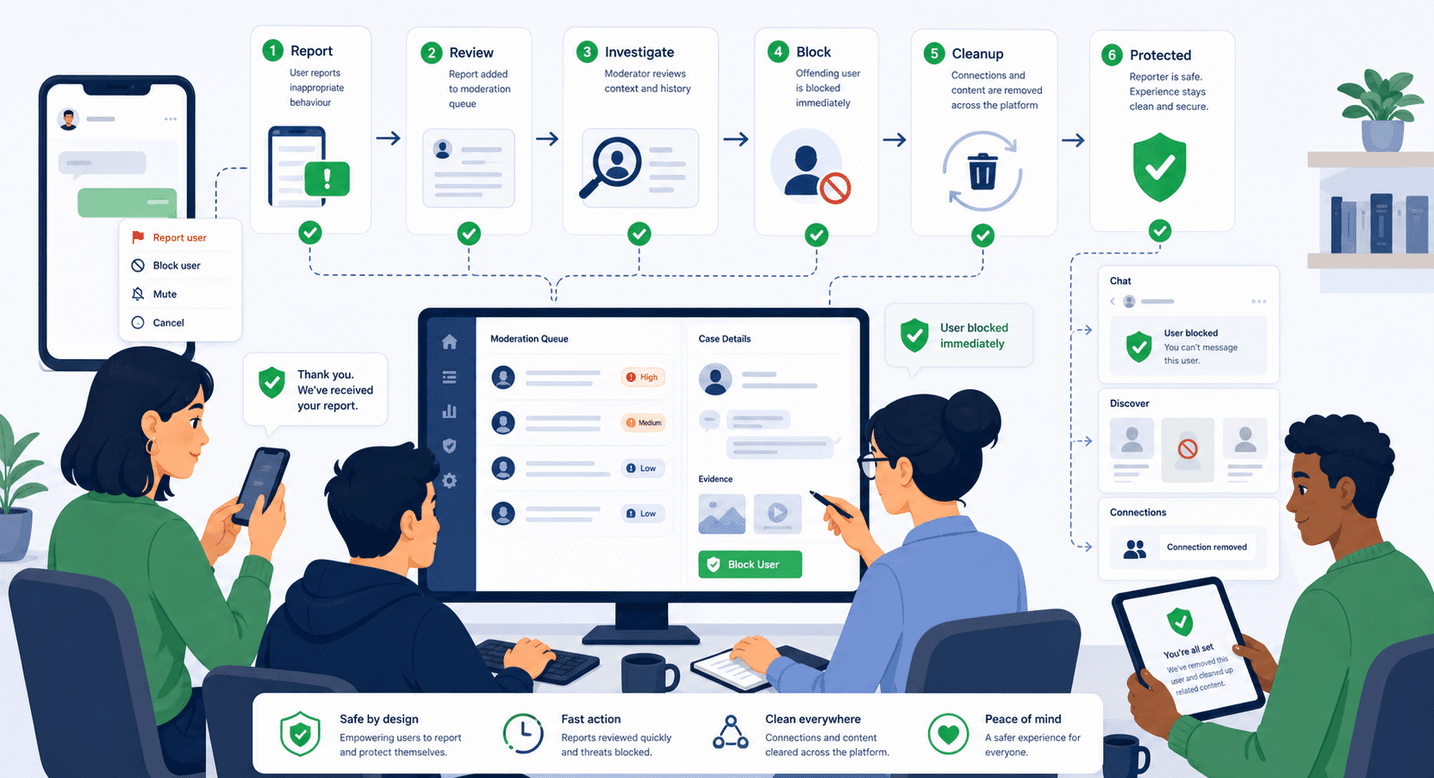
How a mobile-first platform connected report intake, profile blocking, and relationship cleanup so safety actions had immediate effect across the product.
Context
A consumer social platform had the core safety tools users expect, but the flow was spread across different parts of the product and backend. People could report activity from chat and profile views, and they could also block a person, but those actions needed to feel more connected and more immediate. If someone hit block, they should not still appear in edge cases through shared contacts, old chat links, or profile discovery artifacts.
The product already had dedicated app views for in-chat reporting and blocking, plus profile-level safety actions in discovery. On the API side, there were support endpoints and query modules for reports, blocked relationships, and inbox membership. The opportunity was to make all of those pieces behave like one coherent safety system instead of separate actions.
Challenge
The hard part was not building one more endpoint. It was making sure a single safety action had predictable side effects everywhere. A block decision needed to remove two-way social signals, clean up shared spaces, and keep clients consistent without forcing every frontend surface to reimplement cleanup logic.
There was also a moderation workflow concern. Reports needed structured data for downstream processing, while user-facing actions still had to stay quick and simple. Safety actions that feel laggy or unreliable can lead to repeat reports and extra support overhead, so consistency mattered as much as correctness.
Approach
The implementation connected frontend events, API routes, and database-level relationship cleanup into one path. In the app, report and block actions were exposed directly in the chat flow and discovery flow, then routed through support APIs. When a block succeeded, the client emitted a shared event so relevant stores could update their own state immediately. That reduced local drift and avoided brittle cross-store coupling.
On the backend, support routes handled feedback, activity reporting, and block operations with validation at the edge. The safety-heavy path used a transactional query that did more than create a single block row. It also removed glances, favourites, and contacts in both directions, revoked shared album access, and updated chat membership behaviour for private and group contexts. Device-linked blocking data was also created to extend protection beyond a single profile-to-profile record.
Report creation was treated as an evented workflow rather than just an insert-only action. That made it easier to fan out moderation handling without slowing down the user request path. The codebase also keeps dedicated tests around support routes and blocked-profile query behaviour, which helped keep this flow dependable while it evolved.
Outcome
The result was a safer moderation flow with cleaner operational behaviour. Reporting and blocking now read as one connected experience instead of two disconnected forms. From a user perspective, safety actions take effect quickly in the places that matter most, especially active chat surfaces.
From a product operations perspective, the moderation pipeline receives structured report inputs while relationship cleanup happens automatically in the same action path. That lowers manual overhead for edge-case cleanup and reduces the chance of users seeing lingering contact states after a block. The architecture is also easier to extend because the side effects are centralized in query logic instead of scattered across controllers and clients.
Key takeaway
In social products, block and report flows work best when they are treated as system-wide state transitions, not isolated API calls.