
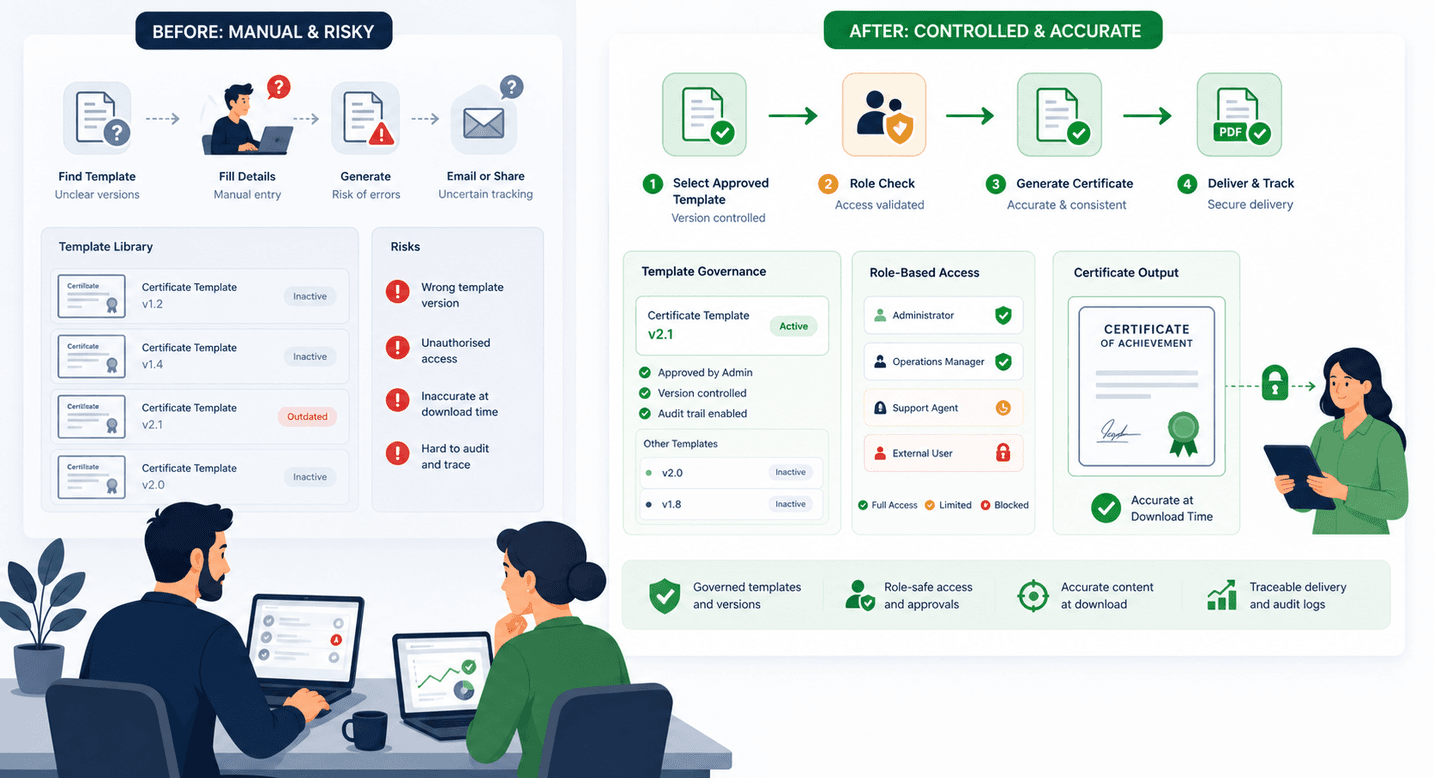
How a regional service provider moved certificate generation into a controlled workflow with template governance and role-safe access.
Context
A needed a dependable way to issue service certificates to partner organisations. The platform already tracked award status and related project data, but certificate creation and distribution needed to be more controlled as usage grew. Admin users wanted flexibility in templates, while organisation users needed a simple download experience for awarded certificates only.
This was less about producing a PDF and more about preserving trust in what the document represents. If a template changes, a download should reflect the current approved layout. If a certificate is still in draft, it should not leak into organisation-facing views.
Challenge
The implementation had to balance governance and practicality. Admin teams needed to manage template metadata like year, page orientation, and page limits. Inactive templates should not be selectable for new certificate records. Award workflows had to optionally notify the organisation contact, but missing contact data should not break the process.
On the access side, organisation users should only view and download awarded certificates for their own organisation. Cross-organisation access had to be blocked. The download path also needed to avoid stale files, especially when branding assets or template details changed.
Approach
I put certificate rendering behind a dedicated service that converts template-based HTML into PDF, stores it in local storage by organisation, and supports fallback behaviour when optional rendering dependencies are unavailable. Template selection is code-driven with a safe default, and shared visual assets are embedded so output remains stable.
The download controller regenerates the PDF at request time before streaming it. That keeps downloaded documents aligned with the active template and current layout settings, avoiding drift between stored files and current template intent.
Template lifecycle controls were added through admin settings. Teams can create, update, deactivate, and remove templates, with validation preventing inactive templates from being used for new certificate creation. Award actions capture metadata such as award timestamps and optional notification metadata when recipient notifications are enabled.
Notification behaviour is intentionally defensive. If a primary contact is available and notifications are enabled, the organisation gets an award message. If no contact exists, the award still completes without crashing and records remain consistent.
Outcome
The team gained a certificate workflow that behaves reliably under real operational conditions. Admin users can evolve templates with controlled activation rules, and organisation users only see what they should see.
Release confidence improved because access rules, award transitions, and notification behaviour are covered in feature tests, including cross-organisation checks and missing-contact scenarios. Day to day, this reduced manual intervention during certificate issuance and made downloads more trustworthy.
Key takeaway
For document-heavy workflows, correctness at the point of download matters as much as correctness at creation. Regenerating from governed templates and enforcing role boundaries makes certificate delivery both flexible and safe.