
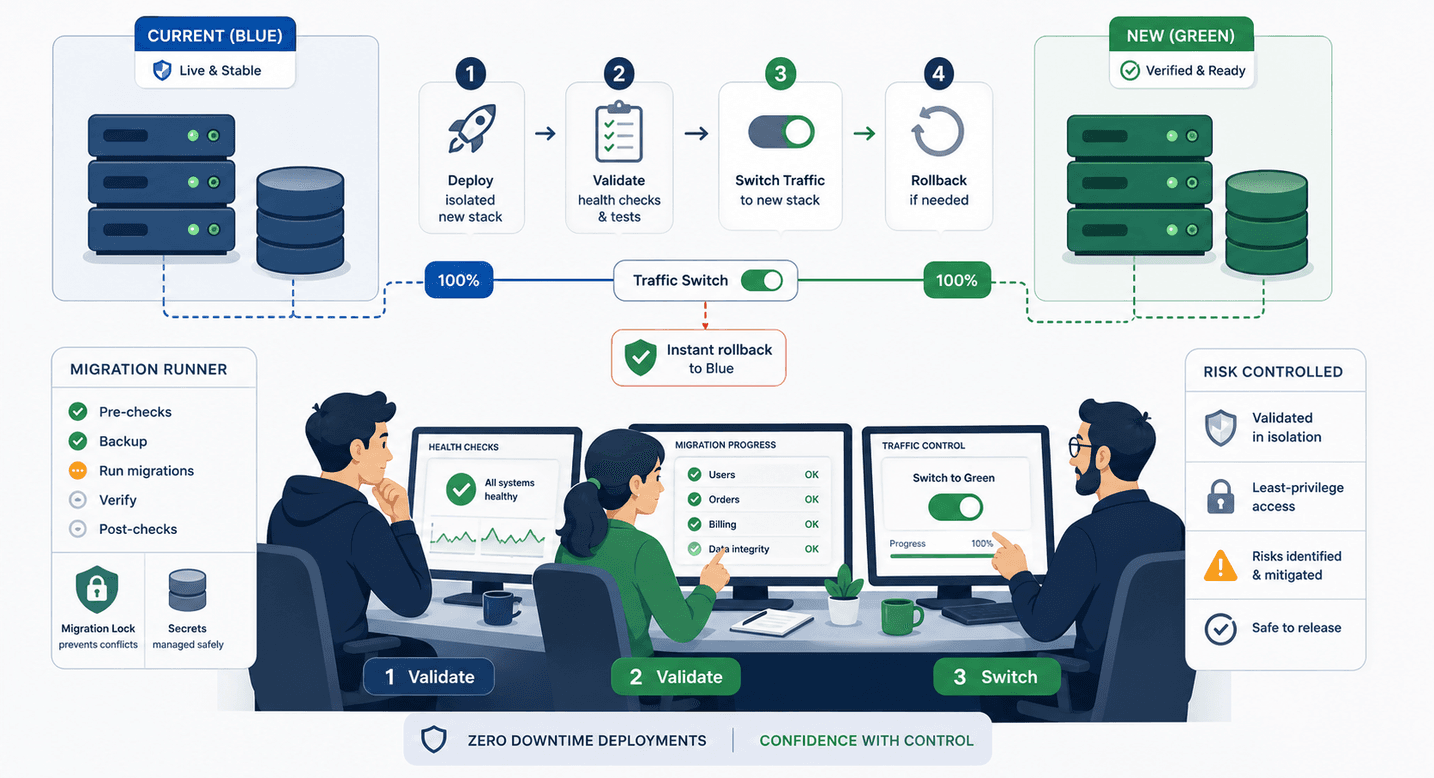
How a consumer social platform paired blue-green deployment practice with a migration Lambda to improve rollback safety and release confidence.
Context
A consumer social platform was shipping frequent backend changes across APIs, websocket behaviour, and data models. The team needed a deployment strategy that allowed real production verification before traffic cutover, plus a rollback path that did not require emergency infrastructure surgery.
The infrastructure already supported stack-based deployments, and the backend included a dedicated migration runner. The real work was turning those capabilities into a repeatable release pattern that developers could use under normal delivery pressure.
Challenge
The main risk was shared-state complexity. Multiple deployment stacks could run at once, but they pointed at the same core data stores. That means schema changes had to be handled carefully so old and new code could coexist during rollout windows.
Operational safety was another concern. Migration tooling is powerful, and without strict control it can become an easy path to accidental destructive changes. The team needed a controlled interface for migration actions, credential handling, and rollback behaviour.
Approach
The deployment process followed a blue-green model: deploy a new isolated stack, verify it, then switch live traffic at the DNS layer. This made it possible to test a full production-like runtime path before cutover, while preserving instant rollback by pointing traffic back to the previous stack.
Database migration execution was handled by a dedicated Lambda runner that loads migration modules explicitly and supports controlled actions like migrate, list, rollback, and seed. Running migrations inside the cloud runtime removed dependency on ad hoc jumpbox workflows and aligned execution with production network boundaries.
Credential handling was environment-aware. In Lambda mode, database credentials were loaded from a managed secret instead of hardcoded values. The migration handler also validates requested actions and constrains raw SQL execution to a narrow safe subset. That extra guardrail is not glamorous, but it protects the system from risky one-off commands during release pressure.
Testing reinforced this operational contract. The repository includes targeted tests for migration handler behaviour, including action validation, secret-loading paths, rollback options, safe SQL enforcement, and expected output shapes. That turned deployment and migration behaviour into code-level guarantees rather than team memory.
Outcome
The team gained faster release confidence with less operational anxiety. New stacks can be deployed and validated without immediately exposing live traffic, and rollback can be done quickly by switching routing back to the previous version.
Migration workflows also became more predictable. With explicit action handling, secret-based credential loading, and defensive constraints around raw SQL, the release process has fewer sharp edges. The combined effect is a safer path for frequent backend changes, especially when APIs and schema evolve together.
Key takeaway
Reliable releases are not just about CI pipelines. They come from combining reversible traffic strategies with migration tooling that is intentionally constrained and test-backed.