
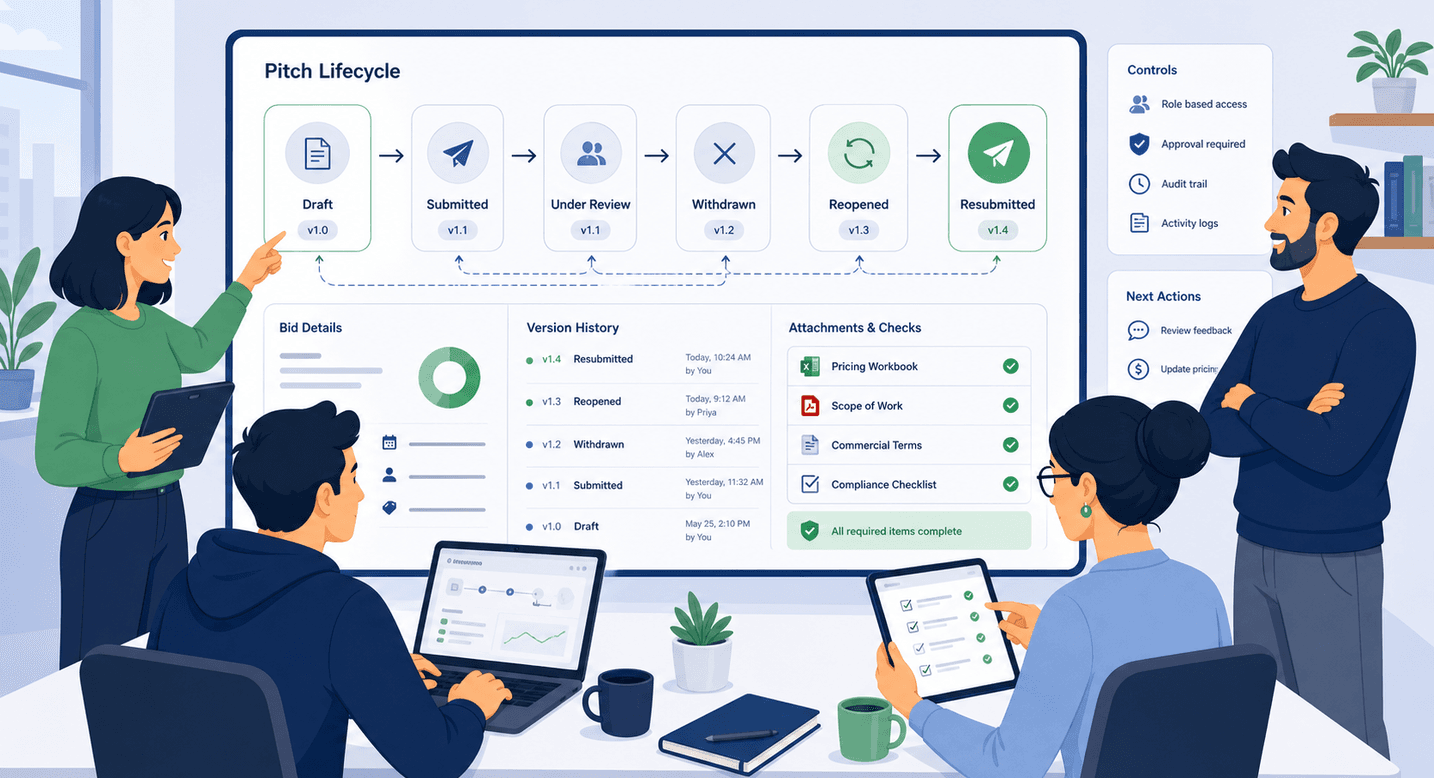
How a multi-location ecommerce business gained tighter control over draft, submit, withdraw, and reopen bid flows with attachment safeguards.
Context
A a multi-location ecommerce business, needed a cleaner lifecycle for tender pitch submissions. Teams were moving through draft, submit, and revision cycles, but the process needed stronger guardrails so states could not drift and attachments stayed manageable.
The existing requirement was not just form submission. It was to support the messy reality of bid work where teams submit, sometimes withdraw, then reopen and revise while a tender is still live.
Challenge
The biggest challenge was state discipline. Users should only edit and attach files while a pitch is in draft. Withdraw and reopen should be allowed only when the tender is still open for activity. Once a tender moves into review, the workflow should block changes that would compromise fairness or auditability.
The team also needed this to integrate with internal notifications. Submission and withdrawal events had to inform the right internal recipients without blasting everyone. Attachment access needed to remain ownership-aware so one organisation could never download another organisation’s pitch files.
Approach
I treated the pitch flow as a controlled lifecycle, not a loose set of endpoints. Creation enforces eligibility checks, including open tenders and invited or already-engaged organisations. Draft applications can be edited and enriched with file uploads, with support for common office and document formats.
Submission transitions the record to submitted, stores who submitted and when, and triggers internal workflow notifications through event-based dispatching. Withdrawal and reopen are explicit transitions with tender-status constraints, so a submission can be reopened for editing only while the tender remains open or early access.
Attachment handling follows the same state model. Upload and delete actions are allowed in draft only. Individual and bulk downloads are supported for authorised users, and record-level checks ensure attachments are bound to the organisation’s own application.
This pattern was backed by feature tests covering not just happy paths but also transition boundaries, forbidden actions after status changes, and access checks from non-owning organisations.
Outcome
The operational result was a more predictable bid process with fewer manual corrections. Teams can iterate confidently when the tender is live, and they get clear limits when a stage is closed. Internal reviewers receive lifecycle signals at the right moments, which improved coordination around incoming submissions.
From a reliability standpoint, the workflow now resists accidental misuse. Status transitions are explicit, file operations respect state, and ownership checks prevent cross-organisation exposure. That improved release confidence and reduced support friction around tender submissions.
Key takeaway
Complex submission workflows stay manageable when state transitions are explicit and consistently enforced. A clear lifecycle with notification hooks and attachment rules creates room for iteration without sacrificing control.